
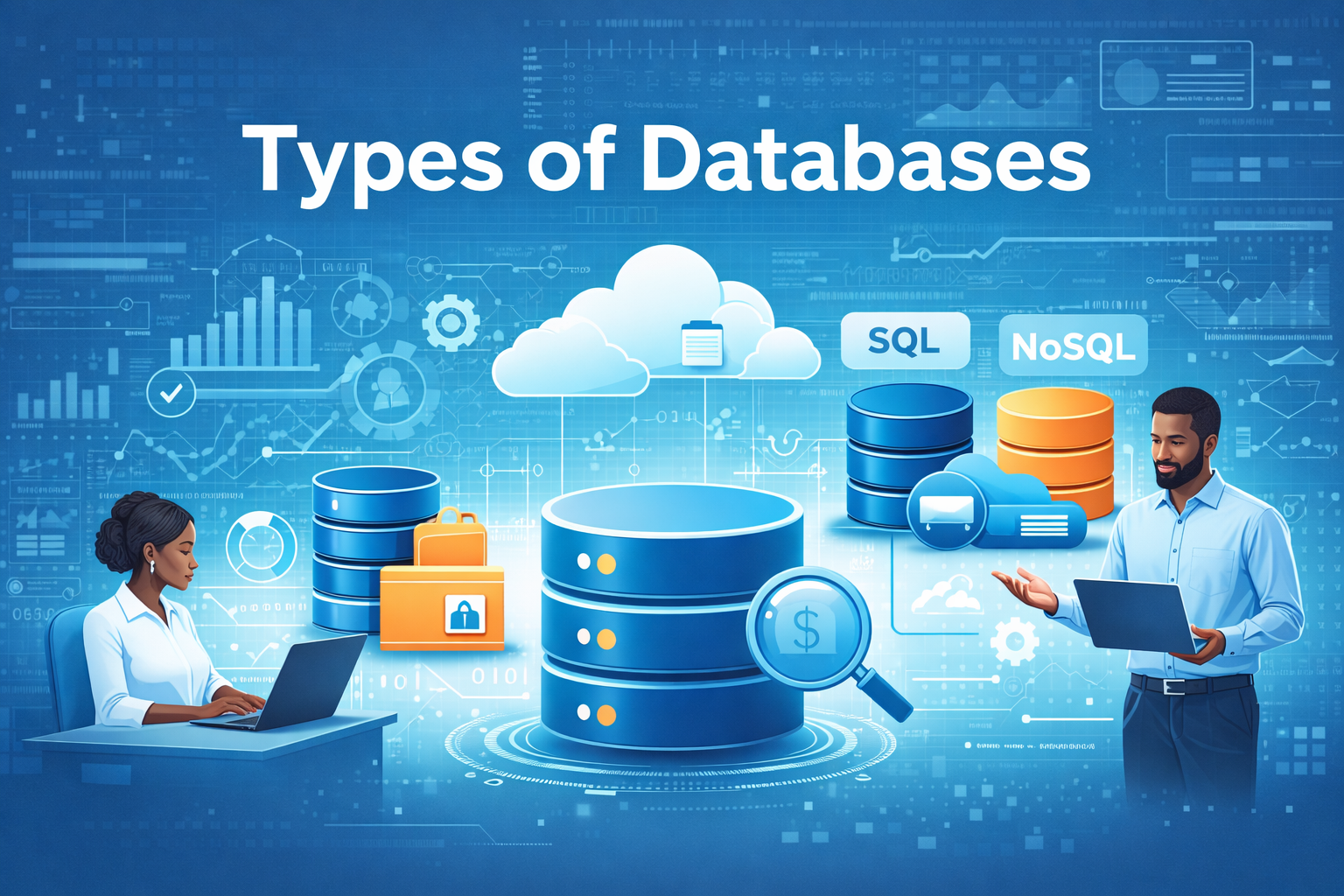
Types of Databases: A Complete Guide for Beginners
In today’s digital world, data is at the heart of every application, system, and business process. From websites and mobile apps to enterprise systems and cloud platforms, databases play a critical role in storing, managing, and retrieving data efficiently.
Understanding the different types of databases is essential for anyone learning data analysis, data science, software development, or IT. This article explores the major types of databases, their features, and real-world use cases.
What Is a Database?
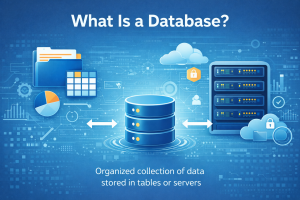
A database is an organized collection of data that allows users to store, retrieve, update, and manage information efficiently. Databases are managed using Database Management Systems (DBMS), which provide tools for data storage, security, and access control.
Major Types of Databases
1. Relational Databases (RDBMS)
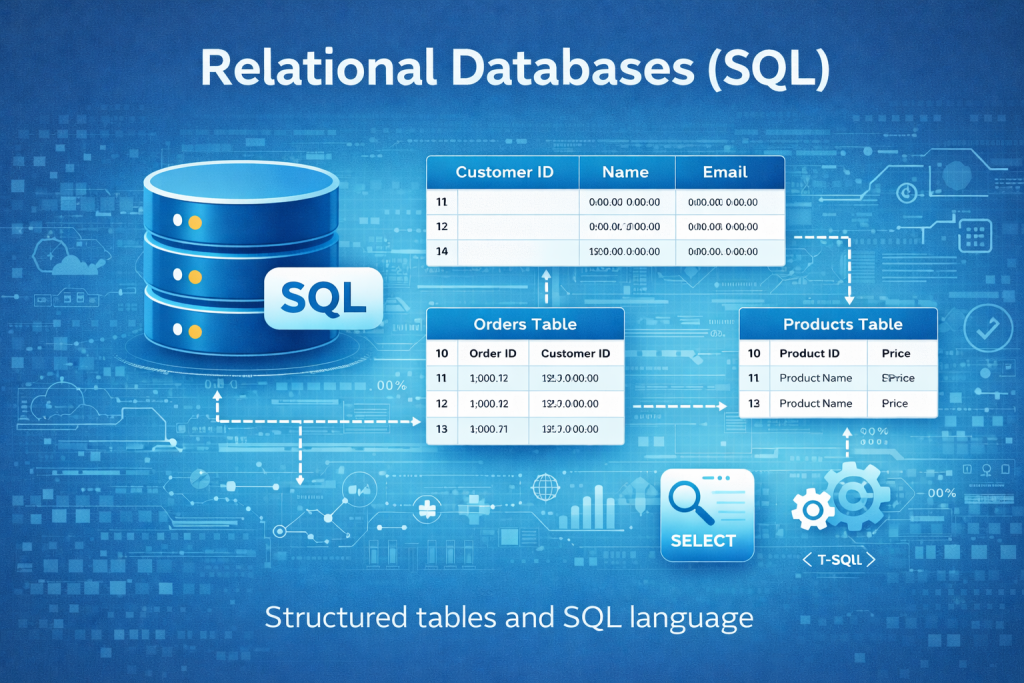
Relational databases store data in structured tables made up of rows and columns. They use SQL (Structured Query Language) to manage and query data.
Key Features:
- Structured data format
- Strong data consistency
- Supports relationships between tables
Examples:
- MySQL
- PostgreSQL
- Oracle Database
- Microsoft SQL Server
Use Cases:
- Banking systems
- Business applications
- Enterprise data management
2. Non-Relational Databases (NoSQL)
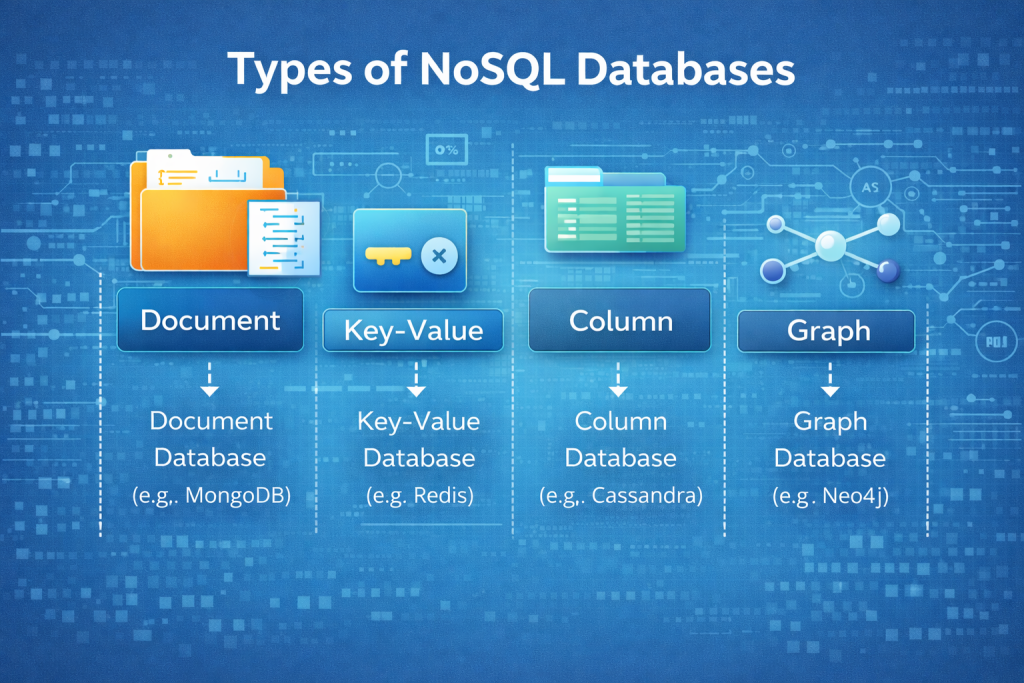
NoSQL databases are designed to handle unstructured or semi-structured data. They are highly scalable and flexible, making them ideal for modern applications.
Types of NoSQL Databases:
- Document databases
- Key-value stores
- Column-based databases
- Graph databases
Examples:
- MongoDB
- Cassandra
- Redis
- CouchDB
Use Cases:
- Big data applications
- Real-time analytics
- Social media platforms
3. Document Databases
Document databases store data as documents, usually in JSON or XML format. Each document contains both data and metadata.
Key Features:
- Flexible schema
- Easy data retrieval
- Ideal for hierarchical data
Examples:
- MongoDB
- CouchDB
Use Cases:
- Content management systems
- E-commerce platforms
- Web and mobile applications
4. Key-Value Databases
Key-value databases store data as pairs of keys and values, allowing extremely fast data retrieval.
Key Features:
- High performance
- Simple data structure
- Scalable architecture
Examples:
- Redis
- DynamoDB
Use Cases:
- Caching
- Session management
- Real-time applications
5. Column-Oriented Databases
Column-oriented databases store data by columns rather than rows, making them efficient for analytics and reporting.
Key Features:
- High performance for read-heavy operations
- Efficient data compression
Examples:
- Apache Cassandra
- HBase
Use Cases:
- Data warehousing
- Big data analytics
6. Graph Databases
Graph databases store data in nodes and relationships, making them ideal for representing complex connections.
Key Features:
- Efficient relationship queries
- Ideal for connected data
Examples:
- Neo4j
- Amazon Neptune
Use Cases:
- Social networks
- Recommendation engines
- Fraud detection
7. Cloud Databases
Cloud databases are hosted and managed on cloud platforms, offering scalability, reliability, and remote access.
Examples:
- Amazon RDS
- Google Cloud Firestore
- Azure SQL Database
Use Cases:
- Cloud-based applications
- SaaS platforms
Choosing the Right Database
Selecting the right database depends on:
- Data structure (structured vs unstructured)
- Scalability requirements
- Performance needs
- Application type
Understanding these factors helps developers and data professionals make informed decisions.
Learn Databases at Techtrainity
At Techtrainity, our training programs cover SQL, database management, and data analytics, providing learners with hands-on experience using real-world datasets. Our structured, instructor-led approach ensures learners gain practical skills that are directly applicable in today’s workplace.
Databases are the foundation of modern technology systems. By understanding the different types of databases, learners can better appreciate how data is stored, managed, and utilized across various industries.
Whether you are starting a career in tech or expanding your skill set, mastering databases is a crucial step toward success.

admin
Ut enim ad minim veniam, quis nostrud exercitation ullamco laboris nisi ut aliquip ex ea commodo consequat. Duis aute irure dolor